Wednesday, January 23, 2013

Age of Bronze 32

 Mythic Manipulations


Readers waited two years between issue 31 and 32. That’s an impressive wait for what once was a monthly comic. Thankfully, it was worth the wait, and there were some good comics to read during the 2010-2012 interim.
  
Age of Bronze is a black and white comic written and drawn by Eric Shanower. It tells the story of the  Trojan War starting from the abduction of Helen to the sacrifice of Iphigenia, to the Achaean landing at Troy and the ensuing siege. In the current story arc, Shanower incorporated the story of Troilus and Cressida.

Age of Bronze 32 continues the story of Troilus and Cressida, lovers foiled by the draconian political demands of war. The story is old, but not quite as old as the Trojan War. The resolution to Troilus and Cressida’s romance is far from secret and can be found in Chaucer, Boccocio, Shakespeare, Dryden , and others, so suspense of how this love story ends (the affair goes badly for  Troilus, prince of Troy) remain dim factors (most likely) for spurring readers to read this story to which they already know the ending.

So why bother reading it at all?

And what of superheroes? Just like readers know how this resolution of this ancient romance, so, too, do we know the origin of Spider-Man , Superman, Magneto, and a host of other characters. So, too, do we know that nothing ever ultimately changes in superhero comics.

Yet this permanence harbors a strength for the story. With the plot and the main details of the story already familiar to the audience (superheroes fight bad guys…Greeks invade the Trojans…Good guys and Greeks win), the variations on the tale (which can theoretically be infinite) accommodate imagination and creativity, yet the ending spot of the story takes the reader and character back to the familiar, to the known.

 So what?

Why bother?

These twice-told tales remain essential. Such adaptations or new versions of the same old stories (like super-hero origin stories) explore the power and possibility contained within the story.  Retellings allow the story to grow, to regenerate, to adapt to needs of both the teller and audience, and still provide familiarity and constant elements that comfort readers and allow a greater chance for the story to endure.

Shanower simplifies this tale of Troilus and Cressida into beginning, middle, and end, with a clear narrative, characters, and setting. An X-Men story, or an issue of  Justice League Dark  imposes a narrative structure within each issue.  Order exists in 20 pages of stapled and folded papers.
 
Shanower’s lines possess preciseness that suggests an architect’s renderings.  These formal sharp lines fit the epic mood of the tale and the place of honor the tale of the Trojan War occupies in western culture.

This rendering of the story draws out the exact treatment of Cressida, the daughter of a traitor, who is delivered from Troy to her father who resides in the Greek camp. How would the Greek soldiers and kings treat this beautiful Trojan woman? Roughly, according to Shanower.


How should a reader respond to these adaptations of “Troilus and Cressida”— as escapism, entertainment, a focus for purging discontent, literary analysis, or a jumping off point for philosophical considerations for a point in the story?  The choice rests with the reader. These multiple retellings and versions of a story, along with contradictory interpretations, can exist simultaneously. A new version of the tale (for example, the Fantastic Four defeating Galactus) can add new twists, details and understanding given the artistic variations and the events going on in the world at the time the work is published.

Superhero comics contain a mythic aspect in the sense that the same stories are relayed, with variations, even though the larger plot remains the same.  This narrative aspect mirrors humanity in that ultimately all of us are born, live, and die. All eat, drink, breathe, learn, love, lose, etc. But even though the lengths and experiences of the lives differ, the beginning and ending remain the same. Nothing ultimately changes with humanity, just like nothing ultimately changes with superhero comics.

 Potential comfort and inspiration await within each variation of the story. So go ahead, grab a book retelling an ancient story, or a book where characters in brightly colored tights and capes and enjoy the variations of a tale to which you already know the ending. 

Tuesday, January 8, 2013

Crisis on Infinite Earths


The Crisis struck me 26 years late; it existed as one of those grand events (like the Great Depression, or World War Two, or the Cuban Missile Crisis) that people I knew experienced, but I did not. Yet I knew Crisis was big not just in its own story, but also with the other stories it inspired (like Secret Wars, Infinity Gauntlet, Civil War, etc.) and reading these later event books seemed to me like reading the Aeniad without having read either the Iliad or Odyssey.  For a first time reader[1] of Crisis on Infinite Earths, the story withstands two and dash of a decade as a great event book because it touches upon and fulfills many traits of a literary epic.

Penguin’s Dictionary of Literary Terms & Literary Theories provides an appropriate working definition of “epic” that works well to illuminate some successful machinations of DC’s 80’s super hero opera:

“A lengthy narrative in which the action, characters, and language are on a heroic level and the style is exalted and even majestic,” some major characteristics of epic are:
  1. a  setting remote in time and place
  2. an objective, lofty, dignified style
  3. a central incident or series of incidents dealing with legendary or traditional material
  4. a  theme involving universal human problems
  5. a towering hero of great stature
  6. super human strength of body, character, mind
  7. superhuman forces entering the action

Superhero comics share a procrustean bed with ancient heroic myths, the kind conveyed through epics (in the literary sense of the word). For the superhero comic book, crossovers are the medium’s adaptation of epics.

Crisis is epic.

Setting
Crisis stretches its tale across a variety of environments, not only with geographic locations but also through multiple times, and various dimensions. Within these times and dimensions characters struggle in space, mountains, cities, jungles, laboratories, space ships, etc. These settings not only cover the remoteness of time and place, but they link this distance to current times and dimensions.

Incident
The main focus for Crisis on Infinite Earths involves the Anti-Monitor attempting to replace our multiverse with his antimatter multiverse. Conceiving a larger event for an epic taxes even the neural workings of Brainiac.

Along with this main incident in the plot, the inspiration for this story lends its strength to increasing the power of this epic event at DC comics. The introduction Marv Wolfman included to the softcover collection of Crisis cites the impetus for the story coming from reading comics in the 60’s and his desire “to see a single story featuring all the DC super-heroes from the past, present, and future.” This desire, carried around for 25 years and undergoing plenty of permutations, became Crisis on Infinite Earths.  

Any literary epic worth its meter includes an invocation to the Muse (Homer did it, Apollonius did it, as did Ovid, Virgil, and even Milton). While Crisis doesn’t contain a call to pagan gods, it does carry an idea which accompanied a writer for over two decades. While the actual workings and implements of the Muse’s assistance continues to be argued, the interest Wolfman possessed to read a tale of all the DC heroes seems to equate (at least in some ways) to having the Muse breathe heavy into an ear.

Crisis happened to be the first grand scale publishing event that showed the way to the following events. This originality, this attempt to “make it new!”, gives an assessment of the work a power boost.  

Theme
One of the questions the Iliad attempts to address is why people do the things they do. Crisis uses an answer to this question as its theme, namely, to save the multiverse, cooperation is needed. 

Characters, both villains and heroes, set aside, some eagerly and others reluctantly, differences in an attempt to halt the Anti-Monitor’s plans. Cooperation for mutual benefit runs through the panels and pages that allows characters to remain true to their ideas, yet knowing what and when to compromise and relax those ideas. This reluctant teamwork stood as a welcome change to current stories where even members of the X-Men and Avengers can’t set aside differences with one another.


Heroes
Of all the traits of a literary epic, the presence of heroes remains the most obvious parallel with Crisis. All the main characters are super heroes.

And there are a lot of heroes. A lot. I remained totally unfamiliar with many of the characters in the DC universe, and the characters from Earth 1 or 3 or X and all the other planes of the multiverse remained elusive. Yet such ignorance on my part didn’t critically hinder the story. Like the references to Philoctetes in the Iliad, more information remains accessible if one has the desire, but not knowing this individual will not utterly destroy an understanding of the poem. The extended full cast of Crisis empowers the book and demonstrates the far reach of the Monitor’s plan.

Just as most people know the story of Odysseus without ever having read the Odyssey, so most comic book fans know Supergirl dies in Crisis. The deaths and returns of super heroes has become mundane, so not much effect was expected from Supergirl’s demise. Yet still, despite knowing what was coming, the death of Supergirl can affect readers. Wolfman’s use of this death lends it strength and purpose.

Doctor Light (a Japanese scientist whose lack of empathy would warm the core of a cyberman) witnesses Supergirl’s battle with the Anti-Monitor. Doctor Light’s character, upon witnessing the principled sacrifice and compassion of Supergirl, becomes more humane and less solipsistic. This death stood as an integral part of the story, rather than simply a death story to strengthen sales. Such moments, even if heavy handed, seem fitting events for heroes to experience and enact in an epic tale.  

Style
While lacking dactylic hexameters and unrhymed iambic pentameters, Crisis generates its lofty and dignified style through another means. The art’s depiction of cosmic events conveys the grandiose element that metered verse carried in textual works. Comic artists face a unique problem ancient rhapsodes didn’t have to consider. How best to depict events of an epic scale? How should cosmic machinations look? Perez handles his depictions masterfully. His space scenes present a sense of awe and wonder and power. Small tight panels seem the norm in the book, and the cosmic backgrounds strike with all the more power when they consume more space than the previous panels.

In the afterward to the soft cover edition, inker Dick Giorano starts off with “Whew. What a read, huh?” The large cast, the cosmic scale, the changes within characters, and the fate of not just the world, or the universe, but multiverses make Giorano’s “whew” appropriate. Crisis on Infinite Earths still stands as a great read. It’s epic.  


[1] No expertise of Crisis is claimed here. I am a first-time reader stirred by this story and am attempting to articulate that stirring and discover the elements of the story that evoked this reaction. The devotion and accolades other readers awarded Crisis, especially Jonathan Woodward’s annotated Crisis (This guy really really likes, LOVES, Crisis on Infinite Earths… Gary Greenwoods also shares this love at The Annotated DC Project) await your discovery at the included links.

Friday, December 28, 2012

Manhattan Projects 1-7


Manhattan Projects:
Scientific Myths

Secrets for building an atom bomb in your basement, won’t be found in this comic book, nor will schematics for inter-dimensional gateways, rocket propulsion, nor do reliable biographies of scientists turn up in these pages of Jonathan Hickman and Nick Pitarra’s tales. Keep grinding through mathematics and physics textbooks if you desire such information (but read Manhattan Projects when taking a break from your studies).

Yet, a mythos of early 20th century science ferments and is cultured in these Manhattan Projects.

Οκ οδ ττι θω,
δο μοι τ νοματα.

I do not know what I think
The minds are two for me
(Sappho, my translation)

Sappho’s words isolate an element Hickman and Pitarra infused within the first seven issues of the Manhattan Projects. Dual simultaneous existence pads through this comic like Schrödinger’s live/dead kitten…a similar mental dance implicit within the above words of Sappho.

While an entertaining comic book and a great story (of which many reviewers already attest to here, here, and here amongst other places), these seven issues scratch at something beyond mere escapism and mundane entertainment. MP both inspires a study of science and horrifies the study of science; two contradictory simultaneously existing states.

Horrification first.

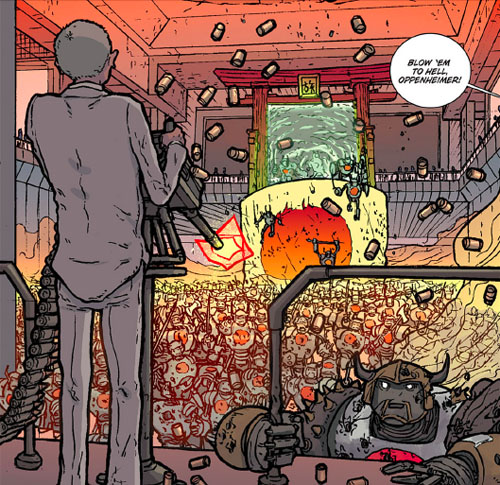
Destruction radiates within the panels of MP. In the first issue, the death of an Oppenheimer along with a high body count of soldiers and Japanese robots could overflow small cemeteries. The death scale increases with the construction and dropping of the atomic bomb (without the consent of the USA president in this version of the tale); an act of destruction wrought by scientists[1]. Hickman expands thanatotic fabrications to include the genocide of an alien race. The unabashed attitude with which General Leslie Groves regards this pogrom comes through a quip used to persuade the Russian scientists to join q scientific alliance, “We killed an entire race of aliens on a Wednesday…who’s going to call our bluff?”

The scientists themselves (in the story, not in “real life,”) get transformed into depraved and monstrous doppelgängers of their actual counterparts. An “evil” Oppenheimer slays his “good” brother and exponentially manifests new personalities while gaining knowledge by devouring (literally) the minds of others. Harry Daghlian metamorphoses into a fleshless radiation monster (the instrument of genocide that razed the alien race with radiation). Einstein (an evil twin from another dimension of our Einstein) devotedly imbibes alcohol with nefarious connotations, while Wernher Von Braun, (in addition to the Nazism) encamps few qualms of sacrificing others for the advancement of science[2], plus he sports a creepy robotic arm. Enrico Fermi embodies an inhuman form (with green skin, sharp teeth, and an aptitude for violence). If monsters “represent fears held by society, fears associated with danger perceived in the surrounding world[3],” then the social apprehension towards scientists and their creations and use of these creations seems difficult to miss.  If such acts and characters don’t horrify and solicit pause for contemplation about the effect of uninhibited scientific research utterly controlled[4] by uninhibited genius madmen, then the back cover of the collection conveys this message with less subtlety than Von Braun threatening to slap an atomic bomb into a Russian research laboratory through an inter-dimensional gate:


And yet, even with such horror, there is the other mind…the box where the kitten still purrs and licks its paws and disregards the flask of poison. This book rouses inspiration and awe for science and scientists.

Ok, sure, readers won’t learn sound scientific principles, or accurate biographies of their favorite scientists, but conveying factual historically documented information is not the strength of fiction, of stories, of myth (whose Ancient Greek cognate μuθοσ can simply mean "story"), but myths, stories, fictions do inspire and shape the events and characters that will become history.

Issue four opens with a quote from Albert Einstein, “Imagination is more important than knowledge. For knowledge is limited, whereas imagination embraces the entire world, stimulating progress, giving birth to evolution.” These stories serve as crucibles for the imagination, the imagination that, “embraces the entire world” and stimulates progress, and gives birth to evolution.”

These stories rouse the curiosity and prompt one to go beyond what rests on the page. Was Von Braun really that callous, did Einstein have a drinking problem, could Oppenheimer possess multiple personalities, was Truman a Mason?

Such questions nag readers and fictional works replete with twisted facts have fired creativity in scientists and others alike. Issue three contains the quote (attributed to Feynman by the fictional Clavis Aurea) “What am I guilty of? An intimate familiarity with the necessity of fiction. Truth is my wife, but lies are my mistress.” Such “lies,” in the guise of fiction, contain truths that influence how people live their lives and the futures they pursue. The MP, in showing the raw power and potential, and sexier possibilities of science and engineering holds such possibility. According to interviews, it wasn’t amiss at the real Los Alamos to find copies of Astounding Science Fiction amidst those working on slicing atoms and assembling rockets, stories that kept minds and dreams in the stars and hands and eyes on calculations and bolts…another dual state of the mind.


[1] Ftting enough, this mood may be captured by the words of the real Oppenheimer upon seeing the explosion of the first atomic bomb…the words he uttered before much more eloquent ones from the Bhagavad Gita, words from the engineer who spent years constructing a project…”It worked.” Then the more poetic, “Now I am become Death, the destroyer of worlds.” Oppenheimer, too, it seems possessed two minds and can relate to the sentiments of Sappho.
[2] The first issue contains the quote from (the fictional) Clavis Aurea’s The Recorded Fenyman
  “I was surrounded by those willing to sacrifice all of mankind if doing so achieved their goals. Evil deeds by evil men that only I could prevent. Mourn then the passing of the world. For when the time came, I could find no good in myself, only mischief.”
[3] As  Matt Kaplan writes on page 4 of his book Medusa’s Gaze and Vampire’s Bite: The Science of Monsters
[4] Von Braun in issue seven works at creating an agency of scientists free from all government control.
Gratitude equivalent to the half-life of Harry Daghlian goes forth to my rocket-scientist cousin for loaning me his collection of MP to read during break. May you always remain beyond the clutches of Von Braun's robotic arm. 

Monday, December 24, 2012

FF #2


Fantastic Finger-Flippin’ Good Fun

The hesitant endorsements of the initial issue of FF metamorphosed into strong confirmations with the installment. Why read comic books recurs as a query from others as well as myself with common frequency; FF #2 contains a partial answer to this question.

While different comics are read for different reasons, an aura of serious whimsical super-hero fantasy remains a realm that comic books handle better than the medium of the novel, poems, films, or television shows. FF #2 provides laughs and superhero antics that shape lips into smiles instead of sneers all while continuing an intriguing story without taking itself too seriously. It offers a fun escape that blends fantasy and laughs to relax the reader yet still excite the imagination.

Kids in comics, while more are needed, can dull a tale when handled ineptly and crash a plot faster than Icarus’s plummet. Yet in FF#2, kids know their place, or rather Fraction knows where to place the kids, and Allred how to draw them. On page two, the Mole children Mik, Korr, Turg, and Tong become the first to realize for sure (and which every reader and character in the comic [with the exception of Scott Lang] also knew) that the Fantastic Four aren’t coming back in forecasted four minutes. Perceptive, and unhesitatingly voicing the obvious, the simple “uh-oh” from Turg wilts the antennas of hope on Ant-Man’s helmet.

Page three contains the moment that confirmed my continued pulling of this issue. A six panel page shows the media reaction to the FF taking over for the Fantastic Four. Panel three depicts Onome reading a newspaper and querying “What is an ex-con?” to Scott Lang as he’s walking across the floor in the background eating cereal. Panel four gives a close up of Lang, helmet off, munching cereal attempting to explain his criminal past to a child. The halting speech; the puffed cheek full of cereal; the tousled hair; the desperate, tired, and conflicted expression of Scott Lang (wanting to be honest and not honest simultaneously) remains a great melding of art and text. The panel captures a true moment of an adult trying to explain a complex and unpleasant idea to a child, while simultaneously dealing with larger world issues. The balance between serious, true, and amusing moments, and super-heroics coalesce on this page, and Fraction and Allred maintain the precarious balance throughout the entire issue. 

Pairing adults unused to dealing with children forever promises a reservoir of laughs (unless you’re the adult). Page seven has She-Hulk giving a law lecture to children. A touching character-defining moment of Darla with Leech and Artie Maddicks follows.

Mole-Man’s attack (just like in Fantastic Four #1) provides some Marvel comics continuity, or at least a reverential homage to Kirby and Lee and we get to  see the FF in action for the first time in the series, complete with fisticuffs and witty banter (“This was supposed to be my day off!” the giant green monster says (the editor kindly translates the “NYARGH*” for readers who haven’t kept their studies of Gigantes) while having Ant-Man knock about in his eye socket and getting strangled by Medusa in a negligee. The only other place (I imagine) one can find such combinations are in magazines better left hidden under the mattress.

All these antics conclude with a genre-demanding cliff hanger ending…some dark form of Johnny Storm flying through a space warp declaring “The Fantastic Four are DEAD! And no one can ever go through that gateway again…”

Fraction and Allred created and delivered a fun comic, a welcome edition to a host of books that are good in a different way (more serious, more experimental, more satirical ) than FF, but FF#2 generates and holds and offers an amusing light-hearted competent romp through the world of super- heroics.

Tuesday, December 18, 2012

Conan the Barbarian #11: The Death Part 2


Conan the Barbarian #11
The Death: Part 2

Script: Brian Wood
Art: Declan Shalvey
Colors: Dave Stewart
Letters: Richard Starkings & Comicraft

The story so far: Controlling an enriching oceanic campaign of plunder ad terror, Bêlit and Conan enjoy a piratical life with their crew aboard the Tigress. Their reputation conveys such power that the mere sight of the Tigress causes other ships to instantly surrender and transfer their cargo to the raiders. A prisoner secured by the Tigress spreads a life-sapping fever amongst the crew. All aboard the Tigress suffer, with the exception of Conan. In issue 11, Conan attempts to find a healer for the crew, experiences a dream vision, and wrestles with the moral choice of whether he should abandon Bêlit.

Barbarian Ethics

Conan has always been a love ‘em and leave ‘em type of guy. A profession of “sword-wielding barbarian mercenary/adventurer” lifestyle doesn’t offer much stability or  promise for an exclusive and devoted domestic life. Conan never pretends otherwise, and at least from the Conan stories I’ve read, his paramours understand the situation and willing lock arms around the barbarian.

Bêlit changes the situation.

While Dave Stewart’s need for blood-red ink remains minimal (which is good since Luther Strode has returned to the shelves and Tradd Moore will monopolize the crimson solution for each page of each issue…) yet Conan’s ethical battle proves greater and far more interesting than any physical foes he’s faced so far in Brian Wood’s manipulation of the barbarian’s tale.

Fever flaunts the question of whether Conan should jettison Bêlit or remain by her side and accept whatever consequences this attachment churns forth. Normally, such a situation would carry a simple answer if some formal ceremony of bonding was present (“in sickness and in health” for “richer or poorer” and so forth) yet, Wood makes Conan’s choice more complex by never having Conan and Bêlit formally and ceremoniously setting forth the conditions of their relationship, and Bêlit states (after saving Conan from a tavern tussle by her mere appearance)
“Conan, my love…carry me back to the ship, back to my Tigress. Make me my tea, and put me to bed. And then you should go.” Bêlit clarifies when Conan asks if he should return to the healer, “No. Go. Leave, leave us. This is a dead end for you. By morning we will all be dead, no doubt.”

Conan’s initial responds by accusing Bêlit of fever madness and exclaims “I cannot. I won’t. I won’t!”

But he can.

Bêlit’s words spiral into Conan’s conscience where he ponders the validity of her predicted demise and command to go, to leave. He struggles with his choice, a choice not based on duty, or obligation, but what seems a pure choice revelatory of Conan’s character and his values and ideals and the man he is and will be.

If ever a Socratic dialogue could take place within a Conan comic, this moment seems an appropriate place to debate and churn the mind for the meaning of “love” and “commitment,” “devotion,” “freedom.”

Robert E. Howard frequently used Conan (as well as other characters) to examine the dark side of civilization and contrast it with a natural state of existence that remains superior to civilization.

This natural state versus civilization works with Conan’s current choice.  When considering whether to return to the Tigress and her ill captain and crew, Conan thinks “What of his promise to Bêlit? For whatever reason, he cannot recall ever making any.” A promise, some vow, some ritual, would obligate Conan and have him shackled to duty to return to Bêlit. Such a move, a binding of words, contains the stain of civilization; a human-crafted device to clarify a desired course of action, a set of choices made in advance. When thinking at night while overlooking the harbor where the Tigress rests at anchor, Conan continues to consider his relation to Bêlit, “Theirs was—is—a romance very much about the present, the simple pleasure of the day to day.” While reveling in each moment, Conan and Bêlit’s romance supersedes a mere groin-grinding dalliance. The first issue makes clear some powerful and unknown might has united Conan and Bêlit.

Neither can clarify the reason for their unification, but neither denies the connection. Some power of nature (always powerful and unknowable despite the best attempts of meteorologists) has united these two humans. Issue five revealed Conan’s prison-bound contemplations of Bêlit’s care and commitment for him (It’s interesting Wood keeps Conan’s mind away from this “debt”;  it certainly makes Conan’s moral conundrum far more fascinating). Conan stands at a threshold as difficult and influential as any hero has faced. The issue ends with Conan stating “I could run. I could be free of all of this. I could have a long life and see the world. It is what Bêlit asked of me. And who am I to refuse a Queen?”

Alas, readers are left to ponder whether the great melancholy expression adorning Conan’s face sprouts from his abandoning Bêlit or from his distaste at returning to the fever-filled hull of the Tigress. Wood masterfully has framed this situation in such a way that the reader’s interpretation of Conan’s expression reveals just as much (probably more) about the reader as it reveals about Conan.

Sunday, December 9, 2012

FF #1

Foundation Flip for for Marvel's Fantastic First Family 

First-time formal introductions rarely generate thrilling moments, even amongst superheroes. FF #1 begins with talking kids, kids that have no immediate clear reason for filling six panels (although the final panel provides the rationale). The comic then paces the reader through each member of the Fantastic Four choosing his and her replacement for their proposed four-minute journey. Each recruitment scene separates with another interview with kids of the Future Foundation.
That’s it.
No villains.
No revealing character developments.
Limited tension in Ant-Man’s reluctance (his obliging answer already known from Marvel’s hype).

The plot exudes the feel of substituting values for the variables in the equation and then calculating the formula…“plug and chug” as the mathematicians say. 


Certainly Matt Fraction’s competence as a writer exceeds question  (his composition on Defender’s #1 still stands as a favorite (for me) first issue of all time), but the purpose for this mild introduction is elusive…for now. Two factors make the second issue worth pulling.

  1. Faith. The bane of loving comics and reading monthly installments… “maybe the next issue will be better….”
  2. Allreds.
Previous replacements for the Fantastic Four 
Mike Allred drawing this new weird team of FF has earned my subscription to this issue. Allred’s running lines for Medusa’s hair, the Kirby-esque Thing[1], and Ant-Man’s costume and  helmet that might be found in the fetish section of a dentist’s supply catalogue straddle the edge of cartoony and realism…a perfect tension to maintain for this FF book (which, despite the slow story, DOES clearly contain a goofy mood). Allred’s style harmonizes with this book, and I hope he stays on art duties for the full four minutes the Fantastic Four uses to walk down their inter-dimensional hallway. I also hope Marvel hires Shakey Kane and David Hine to fill in when Fraction and Allred need a break and to take over at the end of Fraction and Allred’s run…then Marvel universe really WOULD never be the same….

Laura Allred’s eyes are beautiful. Rarely, if ever, has the eye color of a character stood out, but in this issue of FF, the eyes consistently snag attention for an engaging factor of the art. Val and Franklin Richards have blue eyes as does Sue Richards, Mister Fantastic has brown eyes, Ant-Man blue, Medusa, green, Bently-23 brown, Crystal the Inhuman green, She-Hulk green (of course), Darla Deering brown, Johnny Storm hazel, The ever-lovin’ Blue-eyed Thing has…oh…you know…. These small dots of color animate faces far more than what seems possible and conveys a dynamic dynamism to make stunning art that much more stunning.

The first issue’s final page ends with Scott Lang asking:
“What is the FF? What does it mean to you, the young minds that make up the program?”

A good question, and one that kept echoing through my multiple readings and browsings of this issue. As for the bright future engineered by Allred and Fraction…let’s hold hope and keep a pair shades close by for the a possible future so bright.


[1] Sorry Silva, while I know you (and many others) like the look of Allred’s She-Hulk, I just imagine a balloon animals every time she appears on the page with her bulbous muscles…and her shoulders (and breasts) keep changing size…it must make buying properly fitting shirts the height of frustration for She-Hulk…no wonder she gets so angry….).

Tuesday, November 27, 2012

Conan the Barbarian #10:The Death


Navigating love from infatuation to a mature devotion reveals itself trickier than plundering the port-side docks of Argos.

Conan the Barbarian issue 10 begins a new story arc beneath the pen (or keyboard, depending on how the author composes) and kinder arms than Crom’s welcome the artwork of Declan Shalvey. This story, entitled "The Death," takes place after Bêlit and Conan’s return from Cimmeria. A terse overview is provided of life aboard ship, a deck party is thrown, an oracle consulted, fornication transpires, a ship with a lone sailor spotted, and the issue ends with the aforementioned lone sailor dead and bloody upon the deck of his ship. Despite slaughter, pirating, and sailing, all tehse factors seem McGuffins to stronger pulse of the story, an exploration of the evolving love between Conan and Bêlit. Issue #5 exposed readers to the concerns and worry of Conan with his regards to Bêlit. Now, issue #10 lets readers peek upon Bêlit’s concerns regarding Conan.

“Devotion” is the first word the narrator casts to the reader. A concept explored, at least in some part…or actively ignored, by those even brushing love marginally. At the outskirts of ennui Bêlit gives a partial response upon her devotion to the sea and Conan: “N’Yaga, I am bored. And, I fear Conan grows restless.” This prompt, this unappreciated contentment, leads Bêlit to consult the counsel of whatever forces N’Yaga congresses, and churns up The Death.

Bêlit’s boredom involves a reputation so fierce that most ships, spying the Tigress, surrender without a fight. She has a fit sailing vessel, a loyal crew, a strong and sympathetic lover, and she’s not in Cimmeria (always a cause for joy), but atop the waves of tropical climates. In a certain aspect she has a piratical life of piratical heaven, perfection. But anyone who has ever read Book 3 of Paradise Lost, knows that perfection, heaven, is rather dull, and starts longing for a return to the flames that cast darkness and the fiery revolutionary defiant liberty-laden speeches of Satan in Book 2. Bêlit, like Milton (if Blake is to be believed) is also of the Devil’s party. Boredom burgeons her longing for strife, conflict, for something interesting to happen.

“And, I fear Conan grows restless.”

While longing for action, Bêlit also still longs for Conan and tries, inaccurately, to read the mind of her lover (how many of us, oh dear readers, have acted in a similar manner?). It’s not only her boredom she fears, but Conan’s boredom as well. Why would Bêlit, who has been so strong and confident and fatalistic ever since she first appeared, suddenly begin to concern herself with such the restlessness of Conan? And if so, why wouldn’t she just ask Conan if he is restless? Such straightforward questions doesn’t always provide truthful answers, whether from deceit or a fear of harming feelings. The narrator notes “Bêlit’s fears were largely unfounded. Conan the Cimmerian was a happy man. The novelty of a seafarer’s life had not left him, and neither had the repetition—both of action and of diet—worn him down.”

Bêlit, as she has been for most of the story arc, is a ship’s length ahead of Conan. Novelty turns to familiarity, and a diet, no matter how tasty, eventually becomes ashen. Bêlit knows what is coming Conan, for she herself has reached it, and she seeks to push beyond that place where all of one’s dreams have come true. For while seductive, Bêlit knows that such stasis slays one’s soul.

Thus The Death is stirred.

The Death.

Perhaps Wood’s story isn’t just applicable to human love, but the love readers possess for Conan tales. How many times can one read an adaptation of a REH story before becoming bored? How many extrapolations can one read about a reaver, a slayer full of gigantic mirth and gigantic melancholy before becoming restless? Why does almost every interpretation of Conan seem the same as each previous interpretation?

The Death?

In his series, Wood seems to be attempting to give readers some different focus on Conan (certainly Wood isn’t unique in this attempt). Conan, like his franchise, is strong, and primal and can carry multiple interpretation and variations and contradiction is his legends. And what if the Conan continuity should contradict itself? Very well then, it contradicts itself. And still, the character survives.

Bêlit and Conan face a new challenge, one unwelcome, even though sought. It is a challenge of plague and trust and command and survival. It will grow and strengthen their relation, give them another plateau from which to launch their love to a different place in order to preserve it. As for the ultimate success of this series...well, readers are encouraged to consult the seer N'Yaga....