Sunday, October 13, 2013

Aardvark-Vanaheim Pilgrimage: Cerebus Book 2: High Society

Cerebus: High Society


Cerebus High Society
Issues 26-50
May 1981-May 1983
512 Pages

High Society lingered in my memory only as some funny political jibes and a larger theme that lurked in the background that I knew I was completely missing. These indistinct impressions remain from a reading two decades distant of a text over three decades old.  This present reading of Cerebus’s second collected adventures revealed the humor I remembered, it still evoked laughs despite the years passed, and an investigation of power lurched forth as a theme which escaped my earlier perceptions.

High Society doesn’t seem to advance a detailed theory of power in the same sense as Machiavelli’s Prince, or Krishna in the Bhagavad-Gita. Instead it offers vignettes of power, short studies of the effect and reactions that occur when power’s grasped.

Summary: In brief, High Society chronicles the tale of Cerebus serving as governor of the town of Iest and his political campaign to become Prime Minister. The volume begins with the earth-pig aiding two minor thugs in his kidnapping, and follows this antic with his political campaign against a goat for prime minister of Iest. He achieves his position, but through some labyrinthine economical links he abdicates his position and vacates the Regency Hotel, his seat of power during his brief political career.

Setting: The Regency Hotel establishes a magical setting, complete with its  Place doesn’t secure power.
own mystical creature (a flying cheery mildly vindictive elf), an open bar, and insulation from the rabble beyond the doors. This environment illustrates the division between those holding political
power and the populace that must suffer their decisions. The physical remove from the everyday-real-world functioning has Cerebus isolated from the general populace. He has more interactions and conversations with the Elf than any of those who must live with the consequences of his policies. The possession of power creates a chasm between the rulers and the ruled. The outcome of dwelling in this fantasy realm results in abandonment by all his followers and a Regency Hotel surrounded by armed troops.

Voters:  During election campaign for prime minister of Iest, the newspapers print simple sensational headlines in connection to the campaigns. The depth of inquiry remains so shallow in the media that it would be difficult to dampen a bare sock.  If a citizen voter of Iest wanted political understanding, the newspapers offer nothing.

In-depth political insight might be lost however on the population of Iest.  The citizens accept a wild  The intelligence of the voting populace plummets further when the majority can’t distinguish between the goat and the aardvark when casting their ballots. So, while desiring Cerebus for prime minister and verbally denouncing and railing against Lord Julius’s goat, they’re at the same time (unawares) voting for the goat.
and barnyard animal as quality candidates for political office.

When touring and giving publish speeches, Cerebus drew crowds and roused the listeners into some kind of fervor.  The audience remained clueless about the speech’s message (and even who was speaking, many thought Cerebus was the goat) but responded with ignorant mob enthusiasm.  Audiences gained no understanding or conviction.  Power through speech aims to convince an audience but rather to exert a fleeting sphere of influence to manipulate voters to act in the desired manner.  Power here isn’t transformative or empowering but rather manipulative and abusive and deceptive.  Power, political power in Iest, destroys the many for the exaggerated perceived benefits of the few.

Political Deeds:  Governance supposedly provides some efficient orderly method to accomplish tasks on a large scale.  This efficiency doesn’t exist in Iest or the surrounding areas.  Alliances between cities involve a complex manipulation of an economy that has the opacity and logic of a magical illusions performed by crazed followers of Da-Da.  All cities carry massive debts that gain security by borrowing money from other cities with massive debts.  To further complicate matters, no one understands the details of the economic relations and functions.  Such a situation results in permanent monetary crisis.
Attempting to deal with this economic matter directly, Cerebus as prime minister of Iest invades neighboring cities with the intention of using their money to pay off Iest’s debts.  His military attacks are managed by two competent mercenaries whom Cerebus praises for the swiftness and effectiveness of their work.

Yet even these concrete actions and acquisitions of tangible goods (cash and land) the bureaucratic cabal renders worse than useless; instead of alleviating Iest’s debt, the grabs of power only increased the debt as Cerebus becomes responsible for the lands he acquired.  Power hides consequences that manifest only when used.

Motivation: High Society’s exploration of power considers the ambition of the powerless (Astoria) and a figure head (Cerebus). Astoria reveals she wants to use her position to create women’s suffrage; Cerebus wants “more money than anyone else has.”  From these two desires, much creative budget buttressing, manipulation, and compromise leave both main characters of this story arc dissatisfied and disgusted at the conclusion of issue 50.

Astoria: The cold façade Astoria maintains throughout the book unsettled me during the initial  She’s never without a plan, or a back-up plan for her back-up plan.  All of Astoria’s power comes from influencing others, all men (and an aardvark).  Her progressions from Lord Julius to Artemis to Cerebus place her in the proximity of power, but she only ever holds and wields it second hand.  Such a combination warps her humanity into something close to nonhuman.
reading and the second reading as well. Astoria is scary. Reasons for my initial discomfort are unremembered, but in this reading the dedication Astoria has to her task as well as he efficiency she wields in accomplishing it makes one shiver at viewing someone fully dedicated to a single cause utterly believed in. As one without power, she’s willing to lie, manipulate, compromise, and self denigrate so long as her goals become achieved.

Astoria’s lager desire for using her position of influence to expand gain women a political vote receives derision and flip dismissal by the individuals she helped elevate to power.  Her goal is never achieved.  From the sequence of events Astoria’s goal, while noble in one regard, appears foolish when the greedy corrupt workings and universal ignorance of the entire political body or Iest enters into consideration.  Whether foolish or not, Astoria ends the book with nothing (with the possible exception of hidden embezzled cash), not even an avaricious aardvark to manipulate.  

Cerebus: Cerebus’s goal of having more money than anyone else also fails—he leaves the Regency with just a sword and even tosses the duck—the object that could gain and grant him the wealth sought—to shatter on the rocks.

Direct or indirect exercise of power in politics both bring about a bad end. As does dialogue and war.  A noble or ignoble motivation for seizing power also ends with destruction.  Radical fringe political elements like the Anarcho-Romantics offer no hope for a better system of governing.  No rational possibility for power exists in High Society.

Rational Political Chaos: Rational use of power erupts into farce in High Society.   Cerebus drinks (and tricks others into drinking) copious amounts of whiskey as a method for coping with the illogical world of politics.  The entire system of governance reveals itself as a dark and subversive joke directed towards all involved with political process.  As an escape from this comedy High Society offers two solutions. 

The first is putting as much distance between oneself and politics as possible.  The hermit who lives in the distant hills exemplifies this approach. Yet even he can’t escape the political reach of Iest, and he ends up getting slugged in the gut by Cerebus for his participation in political process.
 
The other solution involves fighting fire with fire.  Sitting at the Parnassus of political power, the wild random actions of Lord Julius mirror the amusing farce of political operation.  Power is a cruel joke with no consistent logic.  Lord Julius recognizes the situation and adopts the best method to manipulate and maintain power; laugh and act utterly duck-soup crazy.


For orientation in comics during the three-year publication of High Society Wikipedia offers:


Eagle Awards

for comics published in 1981:
  • Best New Artist: Bill Sienkiewicz[12]
  • Roll of Honour: Roy Thomas
  • Favourite Artist (UK): Mick Austin[13]

for comics published in 1982:
Favourite Artist: Bill Sienkiewicz[8]
Favourite Artist (UK): Brian Bolland
Best Comics Writer: Alan Moore, V For Vendetta (Warrior, Quality Communications)
Best New Book: Teen Titans, by Marv Wolfman and George Pérez (DC Comics)
Best UK Title: Warrior, edited by Dez Skinn
Best Story: V for Vendetta, by Alan Moore and David Lloyd (Warrior, Quality Communications)

for comics published in 1983:

American Section

  • Favourite Artist (penciller): Frank Miller
  • Favourite Artist (inker): Terry Austin
  • Favourite Writer: Frank Miller
  • Favourite Comicbook: Daredevil
  • Favourite Character: Wolverine
  • Favourite Group or Team: X-Men
  • Favourite Villain: Darkseid
  • Favourite Supporting Character: Elektra
  • Character Most Worthy of Own Title: The Spectre
  • Favourite Single or Continued Story: Wolverine #1-4 (miniseries)
  • Favourite New Comic Title: Camelot 3000
  • Favourite Comic Cover: Doctor Strange #55
  • Favourite Specialist Comics Publication: PASS

British Section

  • Favourite Artist: Brian Bolland
  • Favourite Writer: Alan Moore
  • Favourite Comic: Warrior
  • Favourite Comic Character: Marvelman
  • Favourite Villain: Kid Marvelman
  • Favourite Supporting Character: Zirk
  • Character Most Worthy of Own Title: Judge Anderson
  • Favourite Single or Continued Story: Marvelman (Warrior #1-3, 5 & 6)
  • Favourite New Comic: Warrior
  • Favourite Comic Cover: Warrior #7
  • Favourite Specialist Comics Publication: PASS

Roll of Honour

  • Will Eisner


Friday, September 13, 2013

Aardvark-Vanaheim Pilgrimage: Cerebus: Book 1

Cerebus: Book 1[1]

Interested in Sophisticated Fun started the entire matter with his pull and review from the Dig the Longbox on Cerebus 32. The questions raised, and the citing of Cerebus as a classic in independent publishing, and the seeming slip of the earth pig (and his 300-issue chronicle) into the beginnings of obscurity (or so I imagine it. The Comics Store possessed none of the back issues and only the final two trade collections sat on the shelf) prompted a second glance at the 16 volumes sitting on my shelf. The hazy memory of something great having passed, roused the desire for a reading pilgrimage of the 16 books, all 300 issues, of Cerebus.

My first (scattered and stretched out) reading was discontinuous, scattered and stretched between the years 1994-2006.  I’m curious as to how the series stands up to a more concentrated reading (a volume-a-month pace is the one I hope my pilgrim boots maintain). Also, I hate and mourn the possibility of a classic (like the Iliad, Paradise Lost, Orlando Furioso, and The Anatomy of Melancholy, and too too many others…) receiving a culture’s shrug-off when the works have value to offer  modern audiences.

So, with such intentions, and a pen instead of a pilgrim’s staff, the following discoveries arose from the reading of Cerebus: Book 1.


1.
Plot:
The episodic nature of the first 25 issues of the aardvark’s travels could load a general summary with cartloads of meaningless details outside of the specific issue. A swift red-wheelbarrow 25-issue plot summary[2] follows. 

The collection begins with a humanoid aardvark barbarian in a Robert E. Howardesque medieval sword and sorcery world. Other characters acknowledges that Cerebus is a talking upright-walking (physically, NOT morally) animal, but no one seems too bothered by this anomaly or makes too much of it. This avoidance aids the sweep and immediacy of the story, and allows the tales to side step lengthy explanations of how a humanoid animal came about and fits into this world. It just is. The characters accept it. Readers, just accept it. The stories are better for it.

So Cerebus begins undertaking sword-for-hire work for bags of gold, which he promptly spends, loses, or has stolen. The cast of characters he meets (Red Sophia, Jaka, Lord Julius, Elrod the Albino, the Roach, and Weisshaupt) are colorful parodies. Cerebus several times commands armies and stands set to seize great power, but he always loses. Always though, it’s the acquisition of gold and securing of alcohol (whiskey or apricot brandy preferred) that motivates the aardvark. The first collection ends with Cerebus taking lots of gold from an artist/art dealer who feels horrible at the death of Cerebus’s “dear friend” to ease his emotional suffering.

Watching the plans of Cerebus grow in scope seized and maintained attention and curiosity. The picaresque element to the issues roused speculation (and I could be totally off on this) on Sim’s approach to writing. Was he working on establishing a narrative footing?  Was he trying to construct ideas for a large story arc?  Was he maintaining the picaresque tradition of Conan tales and Arthurian romances? I don’t know. But, the story arcs have an organic feel, like they’re unfolding right on the page as it is being written and as it is being read. This gives each tale a freshness, no sense of being overworked, and an easy free flowing of one event to the next.

Cerebus’s character exudes great strength from the first issue. Sim either did a lot of prethinking and prewriting because Cerebus hits the page as a character with a strong and developed personality.  It didn’t feel in this reading that Sim was trying to get a sense of the character, but rather trying to get a sense of ways to tell stories about the character; each issue feels like an experiment, a try out, a tossing of a strong character into a fracas just to see what happens.


2.
Humor:
Cerebus’s humor remains one of the most memorable traits from the first reading. Not funny in the simplistic attempts of Spider-Man humor, or the laughs found in sit-coms, but a slightly darker more jaded lived-in humor. A humor that thou could chuck up the laughs and spin parodies, but at the same time still maintain a sense of seriousness and not fall fully into the realm of farce, a delicate balance to maintain. Cerebus is serious, but not too serious all the time, and it’s funny, but not to the point of inanity…rather like a literary genetic splicing between Robert E. Howard’s Conan the Barbarian and Steve Gerber’s Howard the Duck.

Surprisingly, despite the years that passed since the initial publication of the Cerebus 1, none of the books felt dated (as, say, an issue of the Avengers from 1977 might feel dated when read now). The parodies and farce certainly had links to events in their time, but they hold up on their own. Lord Julius is funny even without any exposure to Groucho Marx. Elrod and Red Sophia hold their own as characters in personalities and deeds. Familiarity with Red Sonja and Elric of Melinboné add an extra layer of chuckles to their presence, but familiarity, even awareness that such characters exist, are not needed to enjoy Sim’s spin on these characters within the pages of Cerebus. This accomplishment of Sim maintained the enjoyment and humor of rereading the stories.


3.
Failure:
While rereading the first 25 issues the amount of failure that befell Cerebus shiver any sense of hope readers may possess.  Cerebus loses bags of gold, positions of power, more bags of gold, health, mobility, political positions, and somewhere along the way his double-horned helmet. Not wanting to make too much of this, but, next to the humor which I rememered and enjoyed as much with the reread. There seems some metaphor or theme lurking amongst the panels. I don’t know if, at the beginning of his run on Cerebus is Dave Sim encountered a host of problems and set backs and failures in the early early days of Ardvark-Vanaheim press and these instances worked their way into the story.

Within the actual context of the story Cerebus does get angry, smashes tables, faces, utters words so vile they can’t be contained within the letters of the English language and at times rages and rages and rages and mumbles angrily a lot under his breath. And yet, thearth pig (in the next issue) is ready to undergo another trial of hardship. He concocts another scheme,and willingly sets himself towards taking another chance. This tenacity and determination works well at giving Cerebus some redeeming character tratis that offset his greed and mercenary tendencies.

While still not too sure what to make of this plot theme, Cerebus as the underdog, err, under aardvark, works well to give Cerebus a difficult to resist charm and makes it easy for a reader to cheer for the earth pig and slant gazes aside when the earth pig is delves into some of his more unsavorary practices.


4.
Art:
A heavy influence of Barry Windsor Smith lurks in the early panels and pages of Dave Sim’s Cerebus. The thick heavy lines slim down soon enough and Cerebus’s portrayal swiftly assumes familiar proportions. Black and white comics (like black and white movies) possess a unique ability to craft and maintain an hypnotic aura. While the beginning few issues maintained a pretty standard but soon Sim begins playing with layouts and perspective that couldn’t be found in any of the big two at this time.  Within the opening book Sim varies the backgrounds from solid black, to solid white, to minimal detail then to intricate detail, the variation enlivens the pages and at times pushes the other objects in the panel forward, while at other times the background pulls the foreground objects away from the reader. This shift, much like Sim’s writing, keeps the pages of the comic lively and fresh.  


5.
Context
The comics of the 1970’s contain the aura and lure of the land of the fae. These yellowing pages obtained the sacredness and illusiveness of the sangrail when referenced in letter pages or an editor’s note. Storylines partially referenced and alluded to in these (what I thought of as ancient) comics excited the imagination and ignited a greedy desire for possession that could rival Cerebus’s desire for gold. With no money, no internet, and no nearby comic shops I was relegated to the comics sold at the local Hallmark and Waldenbooks and those that could be found when the family ventured to flea markets. At times, older brothers of friends (only two collected comics, so it was a limited selection) and I unabashedly completed homework in math, Latin, language arts, chemistry, and civics in return for issues of comics…usually ragged and creased issues from the late 70s and early 80s. So, many of the time-placed references in these early issues of Cerebus surpass my perception. I was one year old when the first issue of Cerebus hit the stands, and not being able to speak, let alone read, I had no chance of persuading my parents to start buying and bagging issues of an obscure comic and explaining the allusions to my infantile mind.

Thankfully though, those writers who stride in the steps of Pliny the Elder and Diderot at Wikipedia compiled basic information on comic books in 1977-79.  1977 is the year Wendy and Richard Pini launched War Graphics. John Byrne and Terry Austin began their acclaimed collaboration on X-Men with issue #108 of the title. The Eagle Awards started and were presented to:

1977 Eagle Awards


1978 Eagle Awards

American section

U.K. section


1979 Eagle Awards

While not necessary to understand Book 1, reading a swift overview of the works that comic readers honored over 30 years ago. Cerebus would certainly disapprove, but, well, so what? The first section of the pilgrimage has started well. Replete with enjoyment, satisfaction, and pleasant surprising discoveries Book1 leaves me eagerly anticipating Book 2: High Society. So let the next step of the pilgrimage begin the trek to and through the Regency Hotel…


[1] For some reason which still escapes me, six months ago I became wide-awake at 2am with the sudden realization that I was done reading monthly comics. There was no debate, no slow snapping of threads or complied frustrations that contributed to this event. I didn’t hate comics, I just realized (it wasn’t even a choice, but rather an acknowledgement of a fact, the way one acknowledges a fact like “it is raining outside”) that the thrill and enjoyment I gleaned from reading and writing about comics vanished is an instant. Literally. I was blind-sided by a black swan. I canceled all of my subscriptions at The Comic Store (and watched as the owner tore up my subscription card right in front of my eyes and said with assurance of a dealer to the most addicted of junkies, “Ahhrrhh, you’ll be back.” … I haven’t yet returned…) and haven’t read a comic book (floppy or graphic novel) since.

I still don’t know why or what caused this divorce. The suddenness and completeness with which it occurred though as certainly caused me to ponder the functioning of the brain and the some fundamental aspects of knowledge and knowing, and the construction of identity. It’s also a bit frightening.

Such is the context for the absence of posts on The Low-frequency Listener.
The reason for THIS post, and the aforementioned pilgrimage is all the fault of my interest in sophisticated fun….

[2] For those of you interested in a more detailed summary of every issue, some (un)lucky folks have already written them (and done a fine job of it from the limited selection I read) at The CerebusWiki < http://www.cereb.us/wiki/index.php?title=Main_Page> Go knock yourself out.

Monday, March 11, 2013

Conan the Barbarian #13: The Woman on the Wall:Part One


Bêlit of Ramah En Ram

Each issue of Brian Wood’s Conan the Barbarian seems to function as an allegory. Readers are reading a story about Conan, but not really, there is something larger going on…like watching The Birds, or reading Moby Dick or some other well wrought piece of literature.  Issue 13’s idea behind the McGuffin holds, if not a set of instructions, at least some considerations for responding to a loved one anchored in anguish.

The opening to “The Woman on the Wall” hits the reader with confusing crush of en media res.  The situation is even more disconcerting since the last time the readers were shown Conan, he was aboard the Tigress, talking at Bêlit, and attempting to aid her. Wood provides readers enough information to clarify Conan’s presence in the large mercenary force besieging the city but it is not until later in the issue. This hesitancy in fully orienting the reader not only serves as an entertaining shift in narrative, but also serves as an apt allegory for Conan’s efforts to succor Bêlit.

The well-walled fortress of Ramah En Ram sits isolated upon a desert plain. The range of tans and yellows used by Dave Stewart in this issue add a layer of heat and oppression and dusty itchiness that leaks discomfort from the page, and makes a reader feel as if they’ve sweated and had it burned away and evaporated from the heat seeping out of the panels. The confusion at the opening of the issue and the dead solitary dry setting serves as a metaphor for the main point of the issue—the mindset of Bêlit.

Bêlit appears in seven panels in this comic, yet she doesn’t speak a single word throughout the issue. In fact, Bêlit spoke only one word in issue 12, “Conan.” These seven panels of silence in issue 13 are the allegorical axis about which the book revolves.

The first of Bêlit’s seven panels is set in the present time of the story. It depicts her standing silhouetted against a rising desert sun standing, alone, upon the ramparts of the fortress wall with her hair blowing in the dry desert wind. The text in the panel reads “As a ghost is wont to do.” No surprise, the “ghost” here is in reference to Bêlit. The image of Bêlit is ghost-like, a silhouette, all details obliterated as she stands in darkness…a cut-out from reality and the rest of life. Bêlit stands apart, alone, an outsider, removed from life, isolated, dead in a certain sense. Yet she’s dead only in a sense, certainly not she’s not bereft of mental or physical power.

The next panel maintains the same setting and provides a close-up of Bêlit with the viewer looking up at her, her right arm stretched forward and her gaze straight ahead, locked and confronting the reader. Pain and loss may exist here, but no weakness, no confusion about the situation which she is undergoing. The divine essence that accompanied Bêlit from when she first appeared in Conan’s dream, and masterfully depicted by Becky Cloonan, still accompanies her in this panel. Mirko Colak, in the positioning of Bêlit in the center of the panel and the orientation of the viewer’s gaze, captures the expression on her face that conveys both the sorrow and power of knowing some divine truth. The text written in this panel is “Every day at dawn, this rose of Ramah En Ram appears, the ghost of the fortress. Is she yearning to see my face, the Cimmerian wonders miserably, or merely scanning the field in hopes of seeing my corpse?” Wood gives the reader two points of view in this narrator’s box. The first sentence comes from the narrator and contains a mere statement of fact. Yet it compares Bêlit to both a rose and ghost, and it situates her appearances at dawn, a time of new beginnings, when the day is full of potential when anything can happen, growth, life, beauty (the rose) or endings, death, despair (ghost). The later half of the text shifts the point of view to Conan who instantly assumes that he is the cause Bêlit’s isolation and the cause of Bêlit’s joy or sorrow. A solipsistic young barbarian male, Conan assumes this situation is all about him and he can’t see, or perhaps doesn’t want to consider the possibility, that he is peripheral to Bêlit’s actions.

In later panels N’Yaga tells Conan “Crom would laugh at you right now. Again, leave her be.” “She is our Queen; we dare not question her. She does as she feels she needs to, and she has and likely always will.” N’Yaga recognizes and respects the power and choice and autonomy of Bêlit and as such lets her live her own life and honors her choices. Conan, for whatever reasons…selfishness, good intentions, most likely some odd tangle of the two, doesn’t or can’t accept this laissez faire approach and sets out on his own to exert his power upon Bêlit. Wood’s script raises the question of what action is best for responding to a loved one’s suffering. Does one step back and let them work it out on their own, or does one step forward and actively offer assistance? Who can know for sure? No wonder Crom laughs.

The third panel in which Bêlit appears shifts the setting to a time in the present story’s past. It shows the bare feet of Bêlit (and some of the best rendered toes every appearing in a comic book) walking away from the Tigress over the wooden pier in the port of Asgalun Shem. The text in the panel reads, “Above all else, Shem is rich, and men are ever fighting over it. This is the land of Bêlit’s birth.” These words, juxtaposed with Bêlit’s steps, show her leaving her crew and career for her home and land, yet violence and fighting still accompany her. The steps from an active roll of dolling out death and violence upon the seas to defending against the violence exerted upon her homeland.

Perhaps the invading army, or at least Conan’s part in the army, represents the good wishes of loved ones trying to reach out and aid those in the midst of suffering? Too often the desire to help and good-intentioned actions are perceived as an attack, a violent exertion of power and control over another person’s life…a control and theft of power for the individual to make her own choices…yet, what happens when the person isn’t in their right mind and isn’t capable of making decisions…and how is an outside party to know that this is the case for the individual? And in the context of our story, how can Conan know? Surely, Crom must be laughing again.

The fourth panel shows Bêlit from behind, wrapped in a faded red cloak with a hood, her hair blowing forward from the wind pushing her from behind. Seagulls soar in the sky on her left, she moves towards a walled city upon a hill which also has gulls hovering above it. Bêlit pauses here, on the threshold of the pier. The next panel (the fifth in which Bêlit appears) has the Pirate Queen turning her head to look back, her hair blowing about her sad eyes. The sixth panel of Bêlit continues the turn of her head to a 7/8’s gaze where she almost gazes full on at the reader. Wood provides no text, and the expression Colak draws for Bêlit’s face holds a host of possibilities: regret, sorrow, a final farewell, disbelief at her past life, a promise to return, a plea for help? The gaze would perplex even Crom. The lack of text in these three panels lets Bêlit serve as a mirror to the reader, letting readers determine what Bêlit shows and feels and how Conan, or any loved one, should respond to a suffering loved one who is walking away from their choices and returning home.

The final panel directs the reader’s gaze so that Bêlit is walking towards the viewer. Conan is silhouetted (just as Bêlit was in her first appearance…here he is the ghost). Two gulls in flight flank Bêlit on both sides and she raises her hood, her back to Conan and the Tigress, with her head tilted down and to the right (towards the direction of Conan). The text: “And so she returns to it. As Conan watches her walk away, he half expects her to fade from view, to be swallowed up into the city, as if she were a ghost. A dream, perhaps. That might be a relief to the Cimmerian. It might spare him a great deal of pain.” Again, Conan sees imagines, even hopes, Bêlit to be a fantasy, a ghost, a vivid dream now ending. He knows that Bêlit’s suffering will cause him anguish too. The final words in this panel, spoken by N’Yaga, offer advice to Conan, “Leave her be, barbarian.”

Conan, in fairness, tries, but he’s never been one for too much inaction. Like Oedipus, he jumps forward and prefers swinging a sword to sitting despite the added trouble and suffering that may accompany it. As for Bêlit and her motivations and intentions and the way in which she came to be in the fortress, they remain an enigma to both readers and Conan. The barbarian has made his choice though, and believes he is acting to the advantage of Bêlit. Whether such belief holds true, who can say? What action best fits how to respond to an anguished loved one? Surely Crom must be laughing still.

Tuesday, March 5, 2013

Kill Shakespeare: The Tide of Blood 1


 Tempest

One of the measures for great literature is its endurance of time…a text that remains supple enough to adapt to an unknown future bolsters its chance at enduring and remaining relevant to some fundamental element of humanity that it reaches and can touch past its age of origin. Shakespeare is really good at touching. 

The current story arc in Kill Shakespeare takes the characters Romeo, Hamlet, Juliet, Othello, Miranda, and others and launches them on new adventures.  Telling new adventures with old characters is nothing new, especially in comics. New adventures of Spider-Man, Batman, the Avengers, and the myriad incarnations of the X-Men have been entertaining readers for over 40 years, so it seems about time that Juliet, Hamlet, and friends cavort in some new tales.

Idolizing great literature as a “hands off” artifact ensures its death faster than instant viewing on Netflix. These adaptations, along with entertaining, serve as fresh corridors for readers to find their way to the plots, scope, and dirty jokes of Shakespeare’s original dramas. Likewise, they serve as fresh lens for those comfortable with plays and poems to consider the works from a different perspective.

The opening four panels mimic the readers’ experience of progressing into a world of fiction. The first panel is a square of black with what looks to be the edge of a leaf of grass cutting into the square from the upper right hand corner with a dew drop hanging from the edge (and another drop following close behind. The tension of the hanging drop mimics the anticipation of the reader at the beginning of the book; where a read still holds onto reality, but gets ready to fall into the story. The second panel has the water drop fall, springing the leaf the up amidst a “V” of tan cuts into the black square, similar to the jolt readers sometimes experience when dropping into the story. The third panel has the drop bursting on the sleeping temple of Romeo with the text of “Bestir…” at the cusp of awakening into a dream of a fresh story and vibrant fictional world. The fourth panel has a wide open eye that looks like Sauron’s eye after a Visine treatment. The text reads “…Bestir, Romeo.” The fully open eye mimics the reader awakening fully into the story, completely absorbed in the tale that unfolds on the page and imagination. Here the reader falls into the tale, fully awakening into the dream world of the story just as Romeo awakens into his own dream within the dream of McCreery, Del Col, and Belanger.

For first time-readers dropping into the third installment of Kill Shakespeare, the creative team supplies them with the needed information to drift into the story. The basic plot of this issue involves a drunken Romeo trying to come to terms with Hamlet having stolen his girlfriend, and an odd set of dreams involving Prospero’s daughter Miranda. When Miranda appears in person, Romeo tosses aside his flask (although one suspects he has a spare) and sets sail with Hamlet, Juliet, Othello, and Miranda to Prospero’s island.

The story is fanciful and fun and there are no pretensions or obscure Shakespeare scholarship that readers need acquire to enjoy this tale.

Visually, Belanger’s inks hold and fascinate the eye. His lines in the panels remain dynamic, but are at their best when chubby and broad in demarcating boundaries.  On page 21, the central panel of nine panels depicts Miranda stating “I come to beg for thy assistance.”  The up-tilt of Miranda’s head, the thick line of her lower-right eyelid and the lower line on her lower lip convey a subtle lushness to the character that simultaneously anchors her in the panel and contributes to her pleading, adding a subtle mark of attraction and beauty to her request for aid.


Miranda stands before a collapsed Romeo who, at the end of his dream, states “I am banished, alone.” One can imagine Caliban echoing this phrase upon Prospero’s island. Yet Miranda’s reply is kinder than the words Caliban would receive from Sycorax, “You are not. I shall come to thee…I promise.” This statement gains gravity with Miranda’s looming stance over Romeo, the hood covering a third of her face gives her the power and presence of one of the Fates, the clutched grimoire and flowing hair express the knowledge and active intention that physically supports her uttered words of support.

Scenes such as these permeate the pages of Kill Shakespeare and reward those willing to read new adventures of some venerable characters in English literature. While reading Hamlet never gets old, and holds rewards and surprises upon rereading; it’s still refreshing to read him in some radically new adventures.


Tuesday, February 26, 2013

Captain Marvel 9 & 10


 Visions of Captain Marvel 10…9…
Revealed through Jack Kerouac’s Essentials of Spontaneous Prose


Captain Marvel Captain Marvel Captain Marvel—Carol Danvers now the Marvel paragon of the sky—the bad-ass kind-hearted boot-wearin’ kicker of the Marvel sky of New York—what is this hold—this captivation—this mesmerism your story contains that escapes other hero books—especially ones with female protagonists—Because the double x chromosomes are integral to Captain Marvel being a great book—She is a super hero but not super in the sense of being too far beyond mundane humanity—Her powers and heroics give her extra abilities yet her mindset stands rooted in the everyday rather than saving the universe or waging Kree or Skrull wars or whatever other matter may occupy the minds of Medusa Sue Richards or Thor—Captain Marvel is one of us—If given super powers a normal human’s thought process and focus would proceed in a manner very similar to Carl Danvers—Yes YES YES this a core part to her appeal! She’s like the reader or rather the reader feels that he is like her in ways that don’t feel possible with the Hulk or Superman or John Prophet—She has a regular apartment neighbors friends appointments to-do lists and a job (flying an airplane…or all things for a superhero with flight powers to do…this one baffles me the most…why Kelly Sue WHY???!).


And what of the art? Artwork on Captain Marvel has always both attracts and deters (but man those covers by Terry Dodson and Rachel Dodson are attractive) and yet the lines and panels of Filipe Andrade have a very nontraditional superhero feel to them—Yet heroics lurk in his lines—When sitting at her table for breakfast the way Carol’s head is propped in her hand—the tightness of the kitchen—the sparseness and tininess of the table makes the whole second panel of the first page seethes with tension—even the cat crouching on the counter looking ready to jump what appears to be a very long distance adds to the tension—and the paradox because at the right end of the panel everything (Carol—the table—the pictures on the wall—the chairs—the vase—coffee—plate and phone on the table seem cramped—yet the left side of the panel seems incredibly open and spacious and accommodating—This juxtaposition in the creation of the paradox holds throughout the book—This paradox (AHH this is the reason Carol flies planes AND can fly with her powers!?) holds part of that fascination—Aspects that shouldn’t go together—and yet they do—and they work (cosmic powers—regular mindset—superhero Avenger—has a job flying airplane—these  things should not be working together and yet they are—Kudos to Kelly Sue for pulling this one off.

Dinosaurs running amok in New York (more paradox and odd juxtapositions…the Jurassic world occurring in the modern world) adds to this fascination—Plus dinosaurs are simply just cool.

Yet the artwork of Andrade seems such an odd fit—Looking at the work with expectations of realism—the proportions of the figures are wrong…legs far too skinny to support the body weight—the space between the eyes seems wide enough that you could land a plane between the sockets—stretching bodies are elongated far past the stretching point of the spine—yet realistic expectations are the WRONG sort of expectations to bring to this book—all expectations are the WRONG expectations to bring to this book—or any book—as a reader just relax and take the art and the story for what they are—Andrade doesn’t put realistic expectations in his panels but the impression—feeling—sense—aura—that does fill the panels  fits with the story and tale and character of Captain Marvel herself—Andrade’s lines MOVE—They move faster than Jack Kerouac on the road with Neal Cassady—Andrade’s stances give the figures an aura of confidence of power of immediacy of AUTHORITY that lends a swiftness and fascination to even some of the more mundane scenes (like when Captain Marvel stands around and talks with Jessica Drew) The hard extreme foreshortened views from a worm’s view visually and instantly depict the grandeur that Kelly Sue has written into this character—A grandeur that is respected—admired—and relateable—The loose lively free suggestive lines of Andrade stimulate rather than stifle the scene—These suggestions—these imperfections I originally called them when taking my numbskull prejudice expecting-realism first glances at the pages—are the very factors that add to the energy and fascination of this book—Andrade’s  style—I’m not sure what you’d call it—impressionistic—European—loose—modern—take whatever label you want—but it doesn’t seem to fit with photographic realism—and yet this none realistic style conveys the realism that can’t be captured with realism—that paradox that haunts the character of Captain Marvel and the tales in this book also haunt the lines and panels and layouts in the artwork—I can’t say as if I understand Captain Marvel or the character or the story or what’s going to happen any better since the beginning of this review—but as far as what hooks and fascinates me with the book—what factor keeps me mesmerized as I gaze and gaze and gaze through the pages wondering why do I like this——lies within the harmony of the paradoxes that spill out upon the page.
 
Keep me perplexed, keep it paradoxical and I’ll keep holding and following the sash of Captain Marvel.


Sunday, February 3, 2013

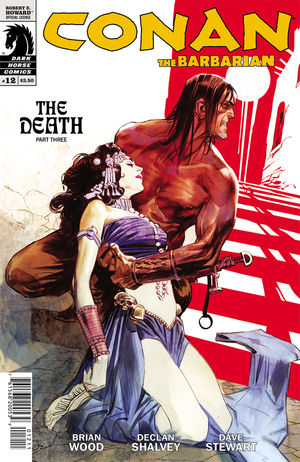
Conan the Barbarian #12: The Death: Part 3


Conan faces foes like he’s never faced in the past 100 issues of Dark Horse’s Conan. Given the barbarian’s rogue gallery, such sinister villainy would seem to strain imaginations, yet Brian Wood takes familiar material in the barbarian's mythos and bends it in a new ways. He makes it look obvious and easy. This current issue evokes “I could have thought of and done that” from readers; except we can’t. Only Wood’s unique voice can sing this song of Conan; which is fine, because the rest of us get to listen.

Conan’s new challengers still lurk in the technological laden 21st century; self-doubt, illness, helplessness at watching the suffering of a loved one. The creative team (Brian Wood, Declan Shalvey, and Dave Stewart on script, art, and colors, respectively) depicts this helpless inaction with some tension and spear throwing to propel the action of the issue.

The pace Wood sets in the 12th issue of his 25 issue run in the port of Bakal sine curves from inaction, to violent action, to debilitated inaction again. In parts one and two of “The Death,” the crew of the Tigress contracted a deadly fever and Conan set out to find a cure. Bêlit numbered among the ill and instructed Conan to leave them while he still possessed his health. Issue 11 ended with Conan trying to decide whether he’d follow Bêlit’s orders. Issue 12 opens with Conan in a tavern, having decided to stay, drinking breakfast and finding some medical help for the crew.

Conan’s immobile brooding drinking soon leads to violent action that raises the apex of the sine curve with some distracting bloodletting as Conan and N’Gora defend their ship against a meager mob.

After the fight, N’gora informs Conan that Bêlit’s screams have been continuous throughout their entire battle on the dock. These howls Wood describes as “It was not the scream of a dying person, but rather the agonized despair of someone in pain with no hope of the release of death.” And having run to the threshold of Bêlit’s room, the narrator says of Conan “He would follow Bêlit to the ends of the earth…but he could not will himself to enter that room.”

This immobility of Conan depicts the helplessness one experiences during the suffering of loved ones. No matter the amount of love, skills, power, and prowess one possesses, it’s useless to the suffering one. Physical pain, perhaps all the more terrible for it, isolates and ultimately must be endured alone.

Wood and Shalvey’s tale captures and heightens this helplessness and isolation with the two-page spread of Conan sitting against Bêlit’s cabin door—all of the space and Conan is alone (except for a dead rat in the lover left hand corner) impotent and waiting. His sword is discarded, tossed on the deck for the useless item it is in this situation. The point of the bloodied blade (symbolic of the dire future for Bêlit?) points at the She-pirate’s door. Conan remains a diminutive slumped figure against a large background, again sitting immobile, waiting amidst Bêlit’s pain-filled shrieks.  No words are given—none are needed here. Both speech and action remain useless as balms for Bêlit.

Bêlit lives, but that doesn’t end the helplessness of Conan. After learning that Bêlit was two months pregnant and that she lost the baby, the captain of the Tigress doesn’t speak. Conan is unsure of the cause, and is again at a loss for how to aid and comfort his companion.

The final three pages of this issue greatly enhance the mood of helplessness. The colors are muted grays and oranges and blacks in depicting a lone ship upon the sea. In the seven panels on pages 20 and 21 where Conan sits in Bêlit’s bed chamber, four of the panels show only one of the couple, alone, which adds to the isolation. Conan’s head always tilts down, and contains heavy shadows. In the three panels where Conan and Bêlit share the space, they are not looking at one another. Bêlit has her head turned away from the barbarian, and after Conan speaks the words, “…Bêlit. Why will you not speak to me?,” Bêlit turns her back to the barbarian. Conan is left helpless and at a loss of how to remedy the situation. The suffering aftermath of the pain Bêlit endures alone, leaving Conan to battle silence, speculation, and doubt alone upon the deck of the Tigress.

Wood’s Conan continues as a fresh and inventive exploration of new possibilities of Conan’s character. While Conan’s adventures still contain high body counts, reading the confrontation of Conan considering the futility of the sword in various situations enlarges the scope and power contained within the character of a young man from harsh northern isolation exploring what the world and life offers.